
1 Introduction
Image classification remains a central problem in computer vision because downstream performance in medical imaging, remote sensing, industrial inspection, and scene understanding depends on reliable extraction of discriminative patterns from heterogeneous visual data [1]. Vision Transformers (ViTs) have emerged as competitive or superior alternatives to convolutional neural networks (CNNs) by partitioning images into patches, embedding them as tokens, and modeling long-range dependencies with self-attention rather than localized convolutional kernels [2]. This architecture has achieved strong results in domains such as remote-sensing scene analysis, texture recognition, and specialized biomedical imaging, suggesting that ViTs can effectively exploit global context and subtle inter-patch relationships when appropriately configured and trained [3]; [4]. Despite these advances, ViTs exhibit structural limitations that make input quality and preprocessing scientifically consequential. Compared with CNNs, ViTs rely less on built-in locality and more on data scale, strong pretraining, and careful optimization to generalize well [5]. They can struggle to preserve low-level spatial and textural cues that may be critical for fine-grained discrimination, particularly in deeper self-attention layers where global mixing can dilute local evidence [6]; [7]. Consequently, several studies introduce architectural modifications that explicitly enhance locality or early-stage feature preservation, including hybrid CNN–ViT designs, token-mixing modules, and residual attention connections that re-inject shallow features into deeper layers [8]; [9]; [7]. These trends collectively imply that the visual statistics entering the patch-embedding stage—contrast, brightness distribution, texture visibility, and noise—can influence what the transformer actually learns from its tokens [2]; [10]. Classical contrast and illumination enhancement techniques, and in particular Contrast-Limited Adaptive Histogram Equalization (CLAHE), offer a practical means to modify these low-level statistics before tokenization. CLAHE aims to improve local contrast while limiting amplification, and several classification studies report gains under appropriate conditions. In retinal OCT lesion classification, CLAHE increased average performance across models and yielded substantial improvements in specific architecture–optimizer settings, whereas standard histogram equalization degraded F1-score by blurring pathology-related structures [11]. Similar behavior has been observed in tuberculosis chest X-ray classification, where CLAHE improved accuracy and other performance measures across multiple CNN architectures [12]. However, enhancement is not universally beneficial: in mammography, CLAHE alone underperformed pipelines that combined it with median filtering and unsharp masking, indicating that naive contrast boosting can obscure or distort discriminative regions. Illumination-oriented methods, including gamma adjustment and Retinex-based low-light enhancement, exhibit the same conditional pattern. Retinex-style processing has produced large improvements in low-light face and object detection performance by correcting global and local illumination [13]; [14]. At the same time, these methods frequently introduce halos, color imbalance, blur, and amplified noise, and recent analyses emphasize that improved perceptual quality does not guarantee better recognition accuracy [15]; [16]. Existing evidence therefore suggests that CLAHE and light-based filters can be helpful when they selectively enhance task-relevant structures, but can be harmful when they over-amplify artifacts or suppress subtle discriminative cues [17]; [11]; [14]. However, the current literature provides little direct guidance on how such preprocessing choices affect ViT-based classification. Most enhancement studies evaluate CNNs, capsule networks, or detectors without transformer architectures [17]; [18]; [13], while most ViT works emphasize architectural innovation, training strategies, or robustness analysis with only cursory or undocumented preprocessing pipelines [19]; [5]; [7]. Comparative enhancement studies frequently lack parameter transparency or systematic ablation, and recent OCT work explicitly notes missing preprocessing specifications as a barrier to reproducibility and fair comparison [11]. Moreover, reported gains often depend on the particular model, optimizer, and dataset rather than reflecting a universally beneficial preprocessing recipe [11]; [18]. This paper addresses these gaps by conducting a controlled, systematic ablation of CLAHE and light-based filtering for ViT-based image classification. We focus on how CLAHE, brightness and gamma adjustment, Retinex-style enhancement, and their combinations alter ViT performance when applied before patch tokenization, under transparent and reproducible parameter settings. Our goals are to determine under which conditions these preprocessing strategies improve or degrade classification metrics, to characterize their interaction with different ViT architectures, and to relate observed performance changes to confusion patterns and error modes. To this end, we evaluate multiple ViT variants on benchmark image datasets under a comprehensive set of preprocessing configurations, measuring accuracy, precision, recall, F1-score, and class-wise confusion. By isolating enhancement components in a systematic ablation framework, the study provides evidence-based recommendations for ViT-oriented preprocessing and clarifies when CLAHE and light filtering should be considered integral parts of transformer-based vision pipelines.
3 Methodology
3.1 Research Design
This study adopts a controlled ablation design to quantify the impact of image preprocessing filters on batik image classification performance. The core idea is to compare model behavior across multiple enhancement pipelines while holding all other experimental factors constant, thereby isolating the marginal contribution of each preprocessing configuration [27]. The Batik-Indonesia dataset is processed under four distinct scenarios, and the resulting image sets are used to train and evaluate identical classifier architectures based on frozen pretrained vision backbones with shallow trainable heads. In all experiments, the backbone parameters of ConvNeXt-Tiny, ViT-B/16, and DINOv2 ViT-B/14 remain frozen, and only a linear classification head composed of fully connected layers with ReLU activation and dropout is optimized, aligning with linear-probing protocols for transfer learning [28]. The same data partitions, augmentation strategy, optimizer configuration, and training schedule are reused across scenarios to ensure that any observed performance differences arise from preprocessing rather than stochastic variation or training hyperparameters. Validation-based model selection is applied for each scenario, while the held-out test set is accessed only once for final reporting, in accordance with leakage-free evaluation practices [23]; [29].
3.2 Dataset Collection and Preprocessing
The experiments employ the Batik-Indonesia image dataset retrieved from the Hugging Face repository, which provides batik pattern images with associated class labels representative of multiple Indonesian batik categories [30]; [31]. Images are first loaded into a Google Colab environment with a mounted Google Drive, and global random seeds are fixed to promote reproducibility. Prior to any partitioning, a Pillow-based validation routine attempts to open and decode each file; unreadable or corrupted images are discarded to prevent training instabilities and label noise, consistent with dataset-integrity recommendations for medical and natural-image benchmarks [30]. After cleaning, the dataset is split once into non-overlapping training (70%), validation (15%), and test (15%) subsets using stratified sampling to preserve class distributions across partitions [23]. The test subset remains entirely untouched until the final evaluation. All images are resized to 224 × 224 pixels to match the input requirements of the ViT and ConvNeXt backbones. During training, only the training split is subjected to stochastic augmentation (e.g., random flips and minor geometric perturbations), while validation and test images undergo deterministic resizing and normalization. Pixel values are normalized using ImageNet channel-wise means and standard deviations to align with the statistics of the pretrained models and stabilize optimization [28].
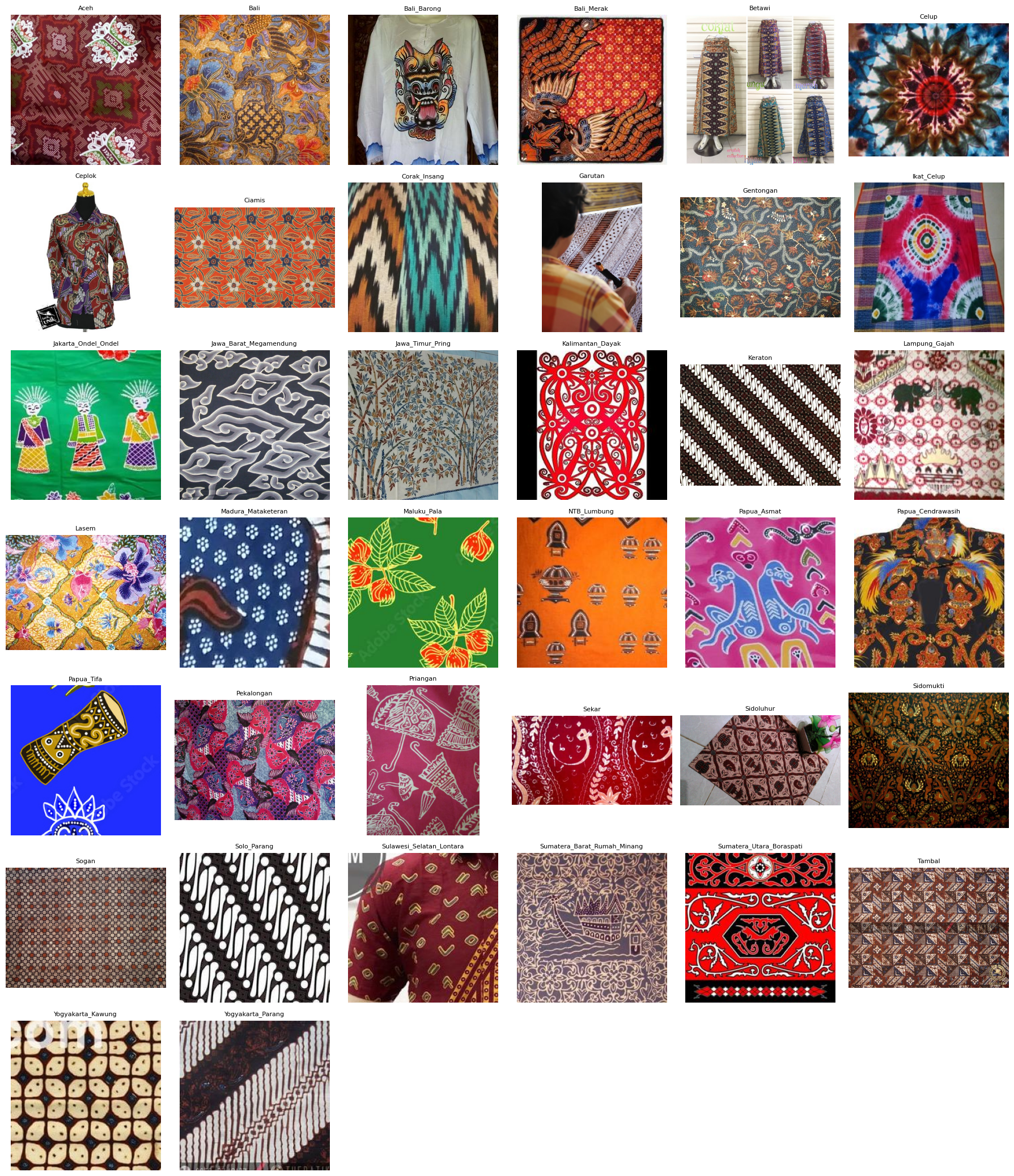
Grid of representative Batik-Indonesia images across the 38 batik motif classes; each tile shows one patterned fabric sample with its class-specific motif, illustrating the visual variety and fine-grained similarity between classes.
3.3 Image Enhancement and Filter Ablation
To investigate the effect of enhancement filters, four preprocessing scenarios are defined and applied to every image in each split: (A) original images without any additional filtering beyond resizing and normalization, (B) contrast-limited adaptive histogram equalization (CLAHE), (C) bilateral denoising followed by CLAHE, and (D) bilateral denoising, CLAHE, and Unsharp Mask sharpening [24]; [32]. Scenario A serves as the baseline control representing a conventional transfer-learning pipeline without explicit enhancement [23]. Scenario B evaluates whether localized contrast amplification alone improves the separability of batik motifs and background. Scenario C adds edge-preserving denoising before CLAHE to suppress high-frequency noise that might otherwise be exaggerated by contrast enhancement. Scenario D further introduces Unsharp Mask to emphasize edges and fine structures that may correspond to intricate batik strokes, following evidence that combined enhancement chains can outperform CLAHE alone in some imaging tasks. Critically, the underlying train/validation/test partitions are identical across scenarios, and all downstream training and evaluation settings are kept unchanged. This controlled ablation protocol allows direct comparison of metrics between configurations and attribution of any performance differences to the presence or absence of specific filters, rather than to sampling or training variability [27]; [23].
3.4 Model Training and Experimental Setup
The classification models follow a frozen-backbone and linear-probing strategy using three pretrained architectures: ConvNeXt-Tiny, ViT-B/16, and DINOv2 ViT-B/14, implemented via timm and the facebook/dinov2 framework [28]; [5]. For each preprocessed image, a 224 × 224 × 3 tensor is passed through the frozen backbone to obtain a global feature embedding, extracted either from the CLS token (for ViT-based models) or from a pooled representation of the final convolutional stage (for ConvNeXt). These embeddings are flattened and propagated through a trainable classification head consisting of a fully connected layer, ReLU nonlinearity, dropout for regularization, and an output layer with as many logits as batik classes. The classification mapping can be expressed as
| (1) |
where denotes the frozen backbone embedding, and are trainable weight matrices, and are biases, is the ReLU activation, and is the vector of class probabilities. All models are trained for 20 epochs with a batch size of 16 using the AdamW optimizer with learning rate and weight decay , combined with cosine learning-rate scheduling to encourage smoother convergence. Mixed-precision computation is employed when a compatible GPU is available to reduce memory usage and increase throughput. The loss function is the standard cross-entropy loss,
| (2) |
where is the batch size, is the number of classes, is the one-hot ground-truth label for sample and class , and is the predicted probability for that class. The model instance with the best validation macro-F1 score within each scenario is selected for final testing to balance precision and recall across classes [33]; [23].
3.5 Performance Evaluation and Ablation Analysis
Performance is assessed on the held-out test set using overall accuracy, macro precision, macro recall, and macro-F1, together with confusion matrices that characterize class-specific error patterns [33]; [31]. For each class , precision and recall are defined as
| (3) |
where , , and denote true positives, false positives, and false negatives for class . Macro averages are then computed as
| (4) |
and
| (5) |
ensuring that each batik class contributes equally to the aggregate metrics, regardless of frequency [33]; [34]. For each backbone and enhancement scenario, test metrics and confusion matrices are computed once using the selected model checkpoint. The ablation analysis then contrasts these metrics against the baseline scenario A to obtain absolute and relative differences in accuracy, macro precision, macro recall, and macro-F1. Learning curves of training and validation loss and macro-F1 across epochs are inspected to identify potential overfitting or underfitting and to determine whether specific preprocessing pipelines facilitate faster or more stable optimization. A summary table aggregates the results across models and scenarios, enabling identification of the best-performing filter configuration and highlighting cases in which enhancement either improves or degrades performance, consistent with prior evidence of task-dependent effects of CLAHE and frozen-feature transfer [24]; [18]; [35]. The overall workflow is illustrated in a six-stage pipeline diagram that begins with dataset loading and seed initialization, proceeds through corrupted-image removal and stratified 70/15/15 splitting, and then branches into the four preprocessing scenarios, each producing 224 × 224 normalized images. These images are passed through frozen ConvNeXt-Tiny, ViT-B/16, or DINOv2 ViT-B/14 backbones, followed by a trainable linear classifier head, and finally evaluated using the aforementioned metrics before cross-scenario ablation analysis.
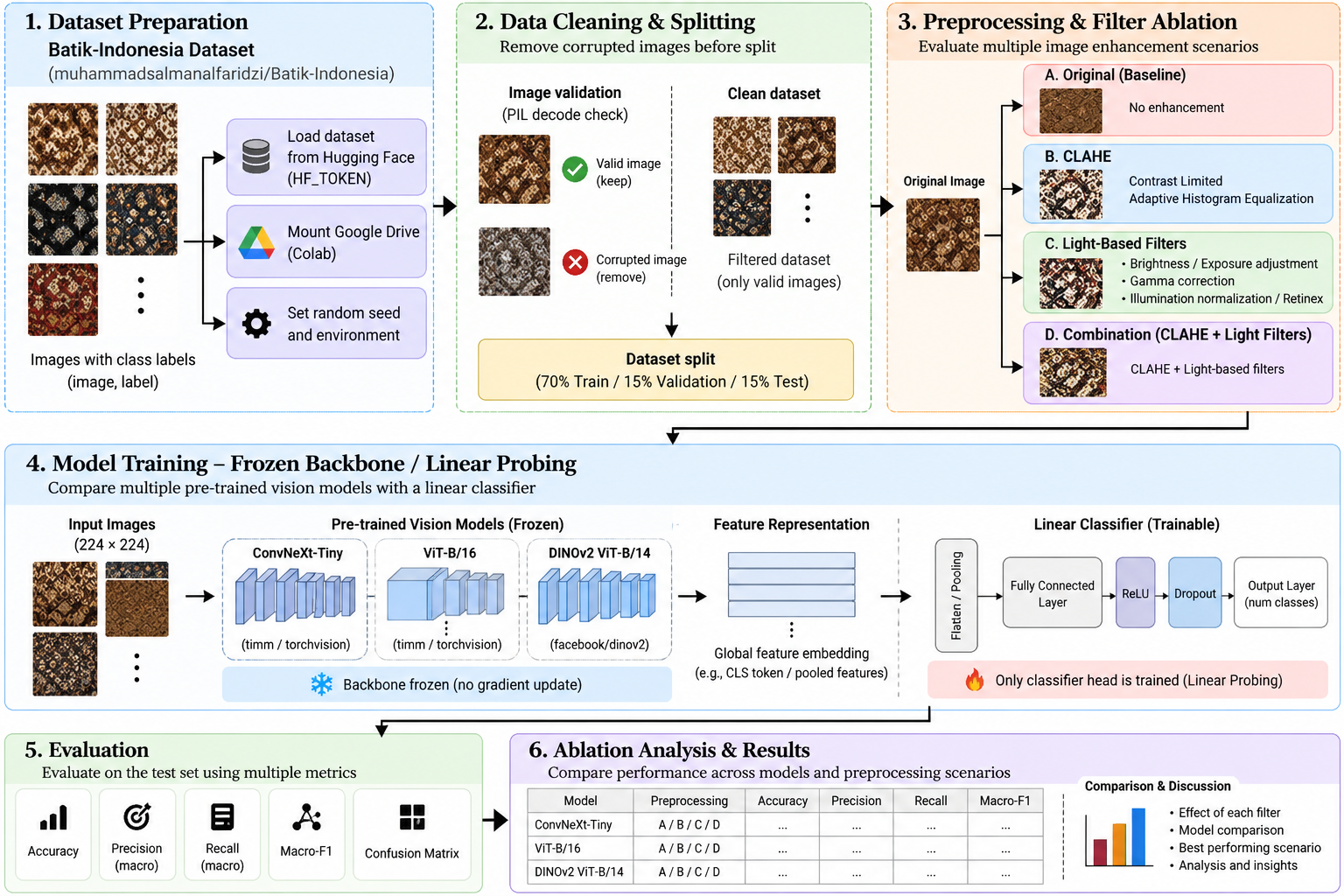
Six-stage flowchart. Stage 1 dataset preparation loads the Batik-Indonesia dataset from Hugging Face after mounting Google Drive in Colab. Stage 2 removes corrupted images and splits the data 70 percent train, 15 percent validation, 15 percent test. Stage 3 branches into the four preprocessing scenarios: A original baseline, B CLAHE, C light filter (bilateral denoising plus CLAHE), D full filter (bilateral denoising, CLAHE and unsharp mask). Stage 4 passes 224 by 224 normalized images through a frozen ConvNeXt-Tiny, ViT-B/16 or DINOv2 ViT-B/14 backbone and a trainable linear head. Stage 5 evaluates accuracy and macro-averaged precision, recall and F1. Stage 6 compares the scenarios in the ablation analysis.
Methodologically, this figure emphasizes the linear and modular structure of the experimental design, clarifying how data progress from raw images to final comparative results. By explicitly encoding the fixed partitions, parallel preprocessing branches, and shared training and evaluation modules, the figure underscores that the only systematic difference between conditions is the enhancement pipeline, thereby strengthening the internal validity of the ablation study.
4 Results
4.1 Validation Accuracy Comparison
Across the four preprocessing scenarios, the ViT model exhibited similar overall learning dynamics, with validation accuracy increasing steeply over the first five epochs and then improving more gradually until convergence around epochs 15–20. All configurations started at approximately 0.56–0.57 accuracy and converged to the 0.72–0.74 range by epoch 20. The CLAHE-only (Scenario B) and light-filter (Scenario C) configurations consistently attained slightly higher validation accuracy than the baseline (Scenario A) after the initial warm-up phase. From roughly epoch 6 onward, both enhanced pipelines tracked above the baseline curve by about 1–2 percentage points, with peak accuracies around 0.74–0.75. The full-filter configuration (Scenario D), which combines denoising, CLAHE, and sharpening, underperformed relative to B and C and remained close to, or marginally below, the baseline after epoch 10. These patterns are reflected in the final test metrics: the light-filter scenario achieved the highest accuracy (0.7487), followed by the baseline (0.7462), CLAHE-only (0.7410), and full filter (0.7333). Although the absolute differences are modest, they indicate that moderate enhancement focused on contrast or illumination yields small but consistent gains over training on unenhanced images, whereas stacking denoising and sharpening does not further improve, and may slightly degrade, performance. This suggests that the pretrained ViT backbone can exploit enhancement-induced improvements in global contrast and illumination statistics, but is sensitive to more aggressive manipulations that may alter fine-grained texture cues [2]; [10].
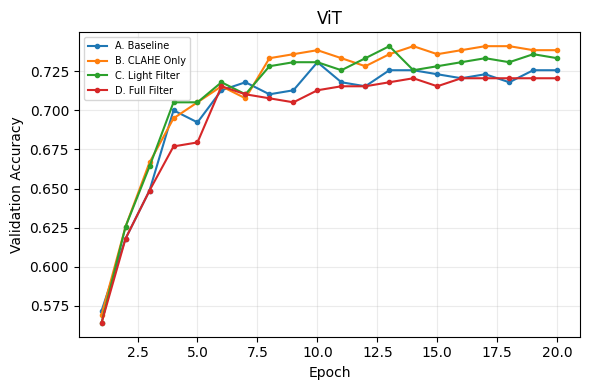
Line chart of validation accuracy for ViT-B/16 over 20 training epochs under four preprocessing pipelines. All curves start near 0.57, rise steeply over the first five to six epochs and plateau at about 0.72 to 0.75; the CLAHE-only and light-filter curves stay slightly above the baseline, and the full-filter curve tracks or falls slightly below it after epoch 10.
4.2 Validation Macro-F1 Comparison
Validation macro-F1 scores exhibited analogous trajectories, rising rapidly from approximately 0.40 at epoch 1 to around 0.55–0.60 by epoch 8, then plateauing with minor oscillations. Macro-F1 complements accuracy by weighting each batik class equally, thereby revealing whether gains are concentrated in frequent classes or distributed more uniformly [33]. The CLAHE-only and light-filter scenarios again achieved the strongest performance, with macro-F1 peaking around 0.59–0.60 and maintaining a small but persistent advantage over the baseline of approximately 0.01–0.02 after epoch 8. The full-filter configuration lagged behind the other enhanced pipelines, especially in early epochs, and never clearly surpassed the baseline trajectory. The pivoted test macro-F1 confirms these validation trends. Relative to the baseline macro-F1 of 0.6011, CLAHE-only improved macro-F1 by +0.0073 (0.6084), the light filter by +0.0071 (0.6082), and the full filter by +0.0051 (0.6062). The close correspondence between validation and test macro-F1 supports the stability of these effects under leakage-free evaluation [23]; [29]. Together, these results indicate that localized contrast enhancement and illumination normalization modestly improve the balance of precision and recall across diverse batik motifs, whereas the combined denoising–CLAHE–sharpening pipeline yields diminishing returns.
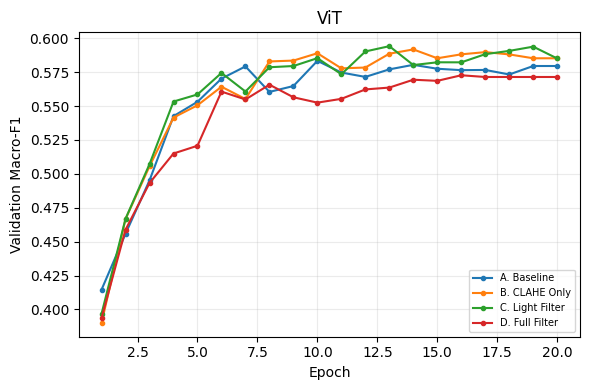
Line chart of validation macro-F1 for ViT-B/16 over 20 training epochs under four preprocessing pipelines. Curves rise from about 0.40 in epoch 1 to 0.55 to 0.60 by epoch 8 and then oscillate around a plateau; the CLAHE-only and light-filter curves hold a small persistent lead over the baseline, while the full-filter curve lags.
4.3 Validation Loss Analysis
Validation loss curves further clarify the optimization behavior under each preprocessing scenario. All configurations began with comparatively high loss values (≈1.8–1.85) and showed sharp decreases during the first five epochs, followed by a gradual convergence phase, indicating stable training and absence of severe optimization pathologies. Among the four pipelines, the light filter produced the lowest validation loss from approximately epoch 3 onward and maintained this advantage through epoch 20. The CLAHE-only configuration generally achieved slightly lower loss than the baseline in mid to late training, consistent with its modest macro-F1 and accuracy gains. In contrast, the full filter exhibited higher loss than the CLAHE-only and light-filter settings and closely tracked or slightly exceeded the baseline in the later epochs. The final test losses mirror these patterns: 1.0755 for CLAHE-only, 1.0786 for light filter, 1.0889 for full filter, and 1.1073 for the baseline. These values jointly indicate that moderate enhancement pipelines not only raise the performance ceiling but also yield smoother and slightly better-calibrated convergence, whereas the full filter may introduce artifacts or information loss that hinder optimization despite similar training conditions [27].
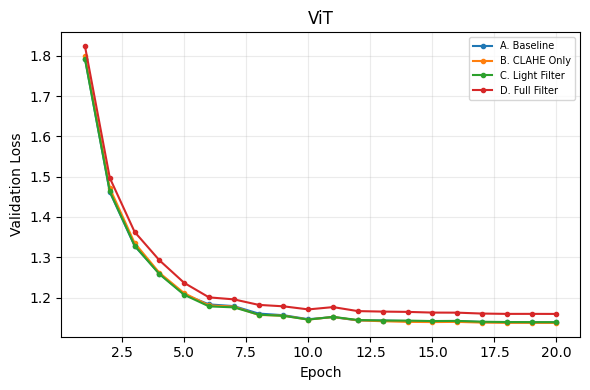
Line chart of validation loss for ViT-B/16 over 20 training epochs under four preprocessing pipelines. All curves start near 1.8 to 1.85, fall sharply over the first five epochs and converge slowly; the light-filter curve is lowest from about epoch 3, the CLAHE-only curve stays slightly below the baseline, and the full-filter curve ends near or slightly above the baseline.
4.4 Confusion Matrix Analysis
The confusion matrix for the CLAHE-only ViT model on the held-out test set reveals a strongly diagonal structure, consistent with the relatively high macro-F1 and accuracy achieved under this configuration. Several batik classes, including Aceh, Betawi, Gentongan, Kalimantan_Dayak, Lampung_Gajah, NTB_Lumbung, Papua_Asmat, Papua_Cendrawasih, Solo_Parang, Sumatera_Utara_Boraspati, and Yogyakarta_Parang, exhibit perfect or near-perfect recognition, with minimal off-diagonal mass. This suggests that CLAHE-based enhancement improves the salience of characteristic motif structures, such as distinctive geometric strokes and regional iconography, without obscuring class-specific patterns [18]. Misclassifications concentrate among visually or regionally related motifs. For instance, Bali is occasionally confused with Bali_Barong and Bali_Merak, which share stylistic and chromatic similarities, while certain Javanese designs (e.g., Jawa_Barat_Megamendung, Jawa_Timur_Pring, and parang-like motifs) show cross-predictions likely arising from overlapping line structures and repetitive patterns. Some Sumateran motifs, such as Sumatera_Barat_Rumah_Minang and Sumatera_Utara_Boraspati, also display intermittent confusion, consistent with partially shared ornamentation. These patterns point to residual limitations in discriminating between fine-grained intra-region variations, even when local contrast is enhanced. Comparative inspection of confusion matrices from the other preprocessing scenarios (not shown) suggests that the baseline and light-filter models exhibit similar dominant diagonals but with slightly higher dispersion in a subset of closely related motif pairs, aligning with their marginally lower macro-F1 scores. The full-filter configuration shows more pronounced off-diagonal entries in several of these challenging class groups, supporting the hypothesis that the combined denoising, CLAHE, and sharpening chain can partially distort subtle textural cues crucial for fine-grained discrimination [11]; [24]. Overall, the CLAHE-only scenario achieves the best trade-off between enhancing motif visibility and preserving discriminative details.
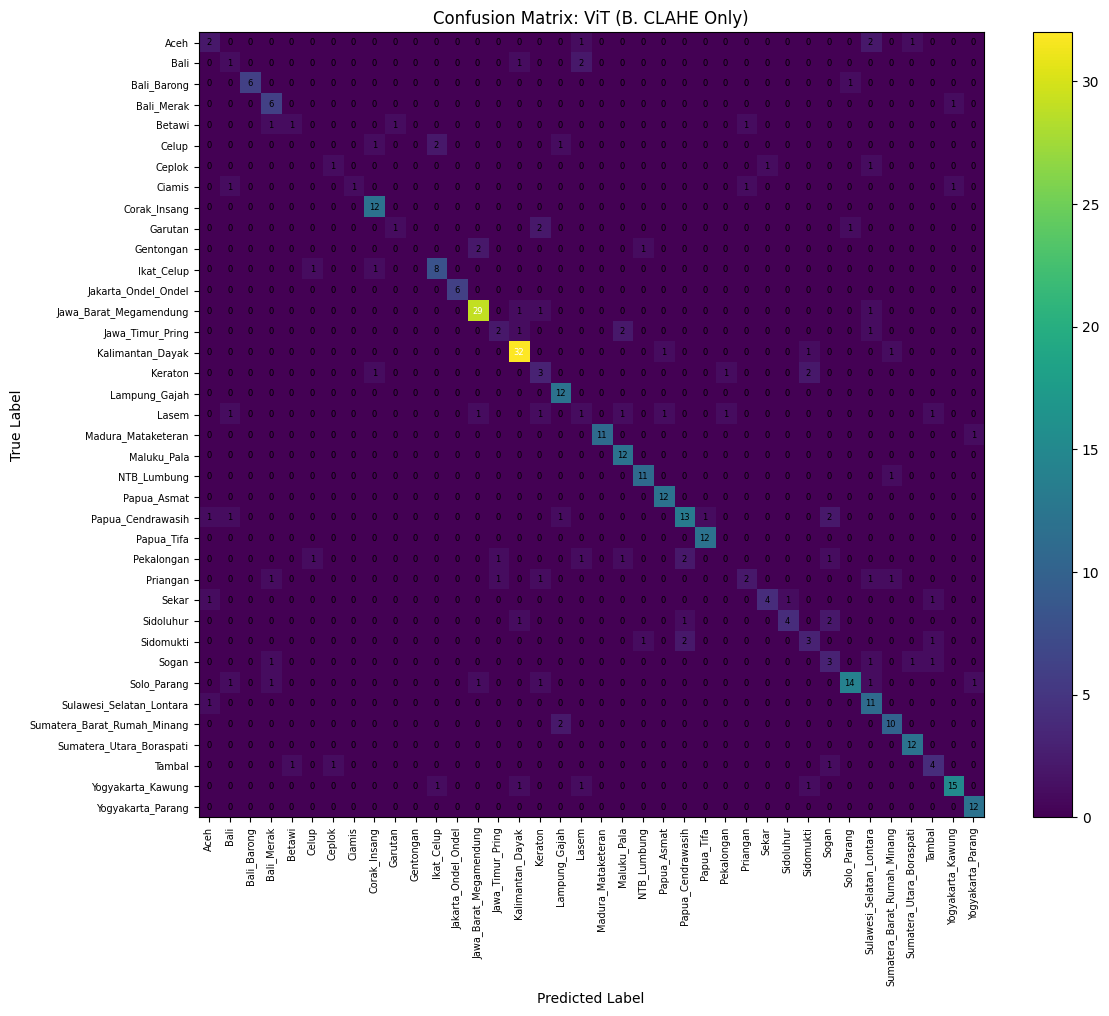
Confusion matrix for the CLAHE-only ViT model on the Batik-Indonesia test set; the matrix is strongly diagonal with near-perfect recognition for Aceh, Betawi, Gentongan, Kalimantan Dayak, Lampung Gajah, NTB Lumbung, Papua Asmat, Papua Cendrawasih, Solo Parang, Sumatera Utara Boraspati and Yogyakarta Parang, and residual off-diagonal confusion between visually or regionally related motifs such as Bali with Bali Barong and Bali Merak.
4.5 Discussion
The ablation results demonstrate that targeted contrast and illumination enhancement can yield small but consistent performance gains for ViT-based batik classification, while more aggressive multi-stage filtering offers no additional benefit and may slightly degrade performance. The CLAHE-only and light-filter pipelines improved macro-F1 by approximately 0.7 percentage points over the baseline, with similar gains in accuracy and reduced validation loss. These findings align with previous reports that CLAHE and illumination-oriented preprocessing can enhance classification in medical and radiographic imaging when they selectively amplify task-relevant structures [11]; [12]; [13]; [14]. At the same time, the limited magnitude of the improvements and the underperformance of the full-filter configuration are consistent with studies warning that over-enhancement can introduce artifacts, blur, or color distortions that do not translate into better recognition accuracy [15]; [16]; [17]. In mammography and chest X-ray work, CLAHE alone sometimes underperforms more carefully tuned pipelines or gamma-based normalization, with performance being highly dataset- and architecture-dependent [24]; [25]. The present ViT-centric results echo this conditional behavior: moderate, carefully configured enhancement helps, but compound chains that include denoising and sharpening risk attenuating subtle textural differences that are informative for transformer self-attention. The observed sensitivity to preprocessing is coherent with the known properties of ViTs. Prior literature emphasizes that ViTs possess weaker inductive biases for locality and translation than CNNs and are more dependent on input statistics, scale, and regularization [5]; [10]. Because ViTs tokenize images into patches and then mix information globally, distortions or excessive smoothing of local contrast within patches can alter the token distribution in ways that propagate through all attention layers [2]; [6]; [7]. The confusion matrix analysis shows that the CLAHE-only pipeline preserves and even clarifies inter-class differences for a wide range of motifs, leading to strong diagonality, while the full filter increases confusion among visually similar classes, suggesting that the additional denoising and sharpening interact unfavorably with patch-based encoding. Compared with CNN-centric enhancement studies, the current work adds controlled, backbone-fixed evidence for ViTs. Most prior evaluations co-vary the backbone and preprocessing, complicating attribution of observed gains [17]; [18]; [23]; [24]. By freezing the ViT-B/16 backbone and varying only the input pipeline under a common linear probing regime [28], the present ablation isolates the effect of CLAHE and light filtering and demonstrates that even a strong pretrained transformer can benefit from modest preprocessing adjustments. This supports the argument that preprocessing choices should be treated as integral design parameters for transformer-based vision systems rather than incidental implementation details [11]; [19]. The study has several limitations. First, it focuses on a single dataset and ViT backbone; the generality of the observed gains across domains such as medical imaging, remote sensing, or low-light scenes remains to be validated [2]; [20]; [21]. Second, filter parameters were selected as reasonable defaults rather than exhaustively tuned, and alternative configurations of CLAHE, gamma, or Retinex-style enhancement may yield different trade-offs [13]; [24]; [25]. Third, the frozen-backbone linear probing protocol, while controlled, does not capture potential interactions between preprocessing and full fine-tuning of transformer layers [28]; [5]. Despite these constraints, the results provide practical guidance. For ViT-based multiclass texture classification, simple CLAHE or light-filter pipelines can be recommended as low-risk, low-cost enhancements that deliver modest but robust gains in accuracy and macro-F1, particularly for classes with subtle motif differences. In contrast, more aggressive compound filters should be applied cautiously and empirically validated, as they may disrupt the fine-grained statistics that ViTs rely on for effective patch-level representation. Future work should extend this ablation framework to diverse datasets, alternative enhancement families, and fine-tuned transformer backbones to more fully chart the interaction space between preprocessing and attention-based visual recognition.
5 Conclusion
This study systematically examined the impact of CLAHE-based contrast enhancement and light-based filtering on the performance of a Vision Transformer model through a controlled ablation design. Across all scenarios, the application of image pre-processing yielded only modest but consistent gains over the baseline configuration. The CLAHE-only condition emerged as the best-performing scenario, achieving the highest macro-F1 score and a small but positive improvement relative to the unprocessed baseline. Light filtering alone produced a very similar macro-F1 to CLAHE, while the full filter configuration, combining both operations, did not provide additional benefit and slightly underperformed the single-step approaches despite incurring the highest training time. These findings suggest that moderate, targeted enhancement of local contrast or illumination can be beneficial for Vision Transformer models in a classification setting, but that more aggressive or compound filtering does not necessarily translate into superior representation quality. The results further indicate that performance improvements are accompanied by non-trivial computational overhead, as all filtered scenarios required longer training times compared with the baseline, with the full filter pipeline being particularly costly. From a practical standpoint, CLAHE-only pre-processing offers the most attractive trade-off between performance and efficiency, providing the highest macro-F1 improvement with a relatively moderate increase in training time. The study contributes a focused, quantitative ablation of commonly used image enhancement strategies specifically in the context of Vision Transformers, where the interaction between patch-based tokenization and pre-processing is not yet fully understood. At the same time, the work is limited by the use of a single model architecture, a single dataset setting, and a fixed configuration of CLAHE and light filter parameters. The observed performance gains, while consistent, are small in absolute terms and may not generalize uniformly across tasks, domains, or transformer variants. Future research should therefore explore a broader design space, including adaptive or learned pre-processing schemes, more diverse datasets and imaging conditions, and different transformer architectures and scales. It would also be valuable to investigate joint optimization of pre-processing parameters and model weights, as well as to assess robustness under distribution shifts and low-quality imaging scenarios, to more fully characterize when and why such filtering strategies meaningfully benefit Vision Transformer performance.
References
- [1] X. Liu and C. Aldrich, “Multivariate image processing in minerals engineering with vision transformers,” Miner. Eng., vol. 208, p. 108599, Mar. 2024. doi: 10.1016/j.mineng.2024.108599.
- [2] Y. Bazi, L. Bashmal, M. M. A. Rahhal, R. A. Dayil, and N. A. Ajlan, “Vision Transformers for Remote Sensing Image Classification,” Remote Sens., vol. 13, no. 3, p. 516, Feb. 2021. doi: 10.3390/rs13030516.
- [3] L. Scabini, A. Sacilotti, K. M. Zielinski, L. C. Ribas, B. De Baets, and O. M. Bruno, “A Comparative Survey of Vision Transformers for Feature Extraction in Texture Analysis,” J. Imaging, vol. 11, no. 9, p. 304, 2024. doi: 10.3390/jimaging11090304.
- [4] L. Yu, “Visual perception based deep learning transformers for classifying paintings and photographs through feature extraction,” Sci. Rep., vol. 16, no. 1, Jan. 2026. doi: 10.1038/s41598-026-36298-4.
- [5] M. Bi, M. Wang, Z. Li, and D. Hong, “Vision Transformer With Contrastive Learning for Remote Sensing Image Scene Classification,” IEEE J. Sel. Top. Appl. Earth Obs. Remote Sens., vol. 16, pp. 738–749, 2023. doi: 10.1109/jstars.2022.3230835.
- [6] A. M. Ali, B. Benjdira, A. Koubaa, W. El-Shafai, Z. Khan, and W. Boulila, “Vision Transformers in Image Restoration: A Survey,” Sensors, vol. 23, no. 5, p. 2385, Feb. 2023. doi: 10.3390/s23052385.
- [7] A. Diko, D. Avola, M. Cascio, and L. Cinque, “ReViT: Enhancing vision transformers feature diversity with attention residual connections,” Pattern Recognit., vol. 156, p. 110853, Dec. 2024. doi: 10.1016/j.patcog.2024.110853.
- [8] M. L. Abimouloud, K. Bensid, M. Elleuch, M. B. Ammar, and M. Kherallah, “Advancing breast cancer diagnosis: token vision transformers for faster and accurate classification of histopathology images,” Vis. Comput. Ind. Biomed. Art, vol. 8, no. 1, Jan. 2025. doi: 10.1186/s42492-024-00181-8.
- [9] O. N. Manzari, H. Ahmadabadi, H. Kashiani, S. B. Shokouhi, and A. Ayatollahi, “MedViT: A Robust Vision Transformer for Generalized Medical Image Classification,” Comput. Biol. Med., vol. 157, p. 106791, May 2023. doi: 10.1016/j.compbiomed.2023.106791.
- [10] Y. Wang, Z. Shu, and Z. Yu, “Efficient Attention Transformer Network With Self-Similarity Feature Enhancement for Hyperspectral Image Classification,” IEEE J. Sel. Top. Appl. Earth Obs. Remote Sens., vol. 18, pp. 11469–11486, 2025. doi: 10.1109/jstars.2025.3560384.
- [11] T. Marciniak and A. Stankiewicz, “Impact of Histogram Equalization on the Classification of Retina Lesions from OCT B-Scans,” Electronics, vol. 13, no. 24, p. 4996, Dec. 2024. doi: 10.3390/electronics13244996.
- [12] V. T. Nguyen et al., “Diagnosing tuberculosis from X-ray imaging based on contrast limited adaptive histogram equalization,” IAES Int. J. Artif. Intell., vol. 15, no. 3, p. 2567, Jun. 2026. doi: 10.11591/ijai.v15.i3.pp2567-2580.
- [13] H. Jiang et al., “R2RNet: Low-light Image Enhancement via Real-low to Real-normal Network,” J. Vis. Commun. Image Represent., vol. 90, p. 103712, 2021. doi: 10.1016/j.jvcir.2022.103712.
- [14] Z. Wang, Y. Qiao, and Y. Cang, “Retinex-based low-light image enhancement with multi-channel feature optimization,” Sci. Prog., vol. 109, no. 2, Apr. 2026. doi: 10.1177/00368504261446453.
- [15] R. Weng, Y. Zhang, H. Wu, W. Wang, and D. Wang, “The Retinex enhancement algorithm for low-light intensity image based on improved illumination map,” IET Image Process., vol. 18, no. 12, pp. 3381–3392, Jul. 2024. doi: 10.1049/ipr2.13180.
- [16] S. Ma, W. Pan, N. Li, S. Du, H. Liu, B. Xu, et al., “Low-Light Image Enhancement using Retinex-based Network with Attention Mechanism,” Int. J. Adv. Comput. Sci. Appl., vol. 15, no. 1, 2024. doi: 10.14569/ijacsa.2024.0150146.
- [17] M. Opoku, B. A. Weyori, A. F. Adekoya, and K. Adu, “CLAHE-CapsNet: Efficient retina optical coherence tomography classification using capsule networks with contrast limited adaptive histogram equalization,” PLoS ONE, vol. 18, no. 11, p. e0288663, Nov. 2023. doi: 10.1371/journal.pone.0288663.
- [18] M. S. Z. Ahmad, N. A. A. Aziz, H. S. Lim, A. K. Ghazali, and A. A. Latiff, “Impact of Image Enhancement Using Contrast-Limited Adaptive Histogram Equalization (CLAHE), Anisotropic Diffusion, and Histogram Equalization on Spine X-Ray Segmentation with U-Net, Mask R-CNN, and Transfer Learning,” Algorithms, vol. 18, no. 12, p. 796, Dec. 2025. doi: 10.3390/a18120796.
- [19] C. Meng, W. Lin, B. Liu, H. Zhang, Z. Gan, and C. Ouyang, “RTS-ViT: Real-Time Share Vision Transformer for Image Classification,” IEEE J. Biomed. Health Inform., vol. 29, no. 5, pp. 3576–3586, May 2025. doi: 10.1109/jbhi.2024.3525054.
- [20] S. Y. Park, G. Ayana, B. D. Wako, K. C. Jeong, S. D. Yoon, and S. W. Choe, “Vision Transformers for Low-Quality Histopathological Images: A Case Study on Squamous Cell Carcinoma Margin Classification,” Diagnostics, vol. 15, no. 3, p. 260, Jan. 2025. doi: 10.3390/diagnostics15030260.
- [21] J. Chen, X. Li, Y. Liu, W. Sun, and C. Yao, “Performance enhancement of visual transformer models via dual-module collaboration for skin tumor classification,” Biomed. Signal Process. Control, vol. 113, p. 108921, 2025. doi: 10.1016/j.bspc.2025.108921.
- [22] T. Hussain, H. Shouno, A. Hussain, D. Hussain, M. Ismail, T. Hussain Mir, et al., “EFFResNet-ViT: A Fusion-Based Convolutional and Vision Transformer Model for Explainable Medical Image Classification,” IEEE Access, vol. 13, pp. 54040–54068, 2025. doi: 10.1109/access.2025.3554184.
- [23] Z. Alhaj and M. Ozturk, “GC-ViT-E: Enhanced global context vision transformers for robust skin cancer classification under severe class imbalance,” J. King Saud Univ. Comput. Inf. Sci., vol. 38, no. 5, Mar. 2026. doi: 10.1007/s44443-026-00680-z.
- [24] A. Sharma and P. K. Mishra, “Image enhancement techniques on deep learning approaches for automated diagnosis of COVID-19 features using CXR images,” Multimedia Tools Appl., vol. 81, no. 29, pp. 42649–42690, Aug. 2022. doi: 10.1007/s11042-022-13486-8.
- [25] R. Abbasi, F. Amin, A. Alabrah, G. S. Choi, S. Khan, M. B. Bin Heyat, et al., “Diabetic retinopathy detection using adaptive deep convolutional neural networks on fundus images,” Sci. Rep., vol. 15, no. 1, Jul. 2025. doi: 10.1038/s41598-025-09394-0.
- [26] C. D. Pavel, S. Moldovanu, I. A. Pavel, O. M. Dragostin, C. L. Chițescu, and C. L. Zamfir, “Hybrid Deep Learning Models for Analyzing Histological Images of the Zebrafish Intestine Under Oxidative Stress,” Diagnostics, vol. 15, no. 22, p. 2859, Nov. 2025. doi: 10.3390/diagnostics15222859.
- [27] M. M. H. Sabbir, N. J. Ritu, M. A. Talukder, M. Kazi, and M. Tabassum, “A Fuzzy Choquet Integral–Based Hybrid Deep Learning Framework for Robust Multiclass Alzheimer’s Detection,” Int. J. Intell. Syst., vol. 2026, no. 1, Jan. 2026. doi: 10.1155/int/4438827.
- [28] H. E. Kim, A. Cosa-Linan, N. Santhanam, M. Jannesari, M. E. Maros, and T. Ganslandt, “Transfer learning for medical image classification: a literature review,” BMC Med. Imaging, vol. 22, no. 1, Apr. 2022. doi: 10.1186/s12880-022-00793-7.
- [29] M. Rifqi Azkiya Jamaludin and C. S. Kim, “Evaluation Integrity in Hybrid Quantum-Classical Skin Lesion Classification: A Data-Leakage Audit and Lesion-Level Correction on HAM10000,” IEEE Access, vol. 14, pp. 101415–101428, 2026. doi: 10.1109/access.2026.3707673.
- [30] K. Abhishek, A. Jain, and G. Hamarneh, “Investigating the Quality of DermaMNIST and Fitzpatrick17k Dermatological Image Datasets,” Sci. Data, vol. 12, no. 1, 2024. doi: 10.1038/s41597-025-04382-5.
- [31] K. S. Chandrasekar, “REGANXNet: GAN-Augmented Hybrid Architecture With LIME- and SHAP-Based XAI Heat Maps for the Classification of Diabetic Retinopathy,” IEEE Access, vol. 14, pp. 58304–58320, 2026. doi: 10.1109/access.2026.3683910.
- [32] P. K. Mall and P. K. Singh, “BoostNet: a method to enhance the performance of deep learning model on musculoskeletal radiographs X-ray images,” Int. J. Syst. Assur. Eng. Manag., vol. 13, no. S1, pp. 658–672, Jan. 2022. doi: 10.1007/s13198-021-01580-3.
- [33] K. Ali, Z. A. Shaikh, A. A. Khan, and A. A. Laghari, “Multiclass Skin Cancer Classification using EfficientNets – A First Step towards Preventing Skin Cancer,” Neurosci. Inform., vol. 2, no. 4, p. 100034, 2021. doi: 10.1016/j.neuri.2021.100034.
- [34] A. J. Parathanath and M. A, “CBMNet: a dual-attention enhanced ConvNeXt model for accurate G.V. Black type I–III classification in intraoral periapical radiographs,” Sci. Rep., vol. 15, no. 1, Nov. 2025. doi: 10.1038/s41598-025-22975-3.
- [35] X. Tang, X. Yue, H. Mane, D. Smolyak, D. Li, Q. Nguyen, et al., “Robust and scalable representation learning for Google Street View-based neighborhood indicators,” Neurocomputing, vol. 700, p. 134443, Nov. 2026. doi: 10.1016/j.neucom.2026.134443.