
1 Introduction
Javanese script, or Aksara Jawa, constitutes a significant component of Indonesia’s written cultural heritage, encoding historical chronicles, literary works, and regional identity across centuries [1]. Its everyday use has declined in favor of Latin script, raising concerns that large volumes of handwritten and printed Javanese materials will remain inaccessible to younger generations and digital scholarship without targeted preservation efforts [1]. Within this context, optical character recognition (OCR) and handwritten character recognition (HCR) are increasingly framed not only as technical challenges but also as enabling technologies for digital archiving, search, and interactive learning tools that can support independent practice and script retention among students [2]; [3]. Similar arguments have been advanced for other ancient and regional scripts, where deep-learning-based OCR is seen as a practical means of bridging cultural heritage with contemporary digital infrastructures, yet progress for low-resource scripts lags behind that for Latin, Chinese, and Arabic [4]; [5]; [6]. Despite its importance, Javanese Aksara poses distinctive technical challenges for automatic recognition. The script includes complex graphemes, numerous diacritics, and many compound forms that extend well beyond the 20 basic Carakan characters often used in simplified studies [1]; [2]. When the class space is expanded to include sandhangan and conjunct-like combinations, intra-class variability and inter-class similarity both increase, making misclassification more likely [2]. More generally, handwritten character recognition for low-resource scripts suffers from visually similar symbols, recursive or ornate structures, writer-specific variations, nonuniform spacing, curvature, and class imbalance, all under conditions of limited publicly available data and weak reproducibility [6]; [7]; [5]. In the case of Javanese, many existing studies still restrict themselves to basic characters and small, relatively balanced datasets, which can yield high reported accuracies while leaving generalization to more realistic usage scenarios uncertain [3]; [2]. Within this landscape, preprocessing is recognized as a potentially important lever for improving recognition, but its role in Javanese pipelines remains underexplored. Prior Javanese work has shown that aggressive thinning or heavy binarization can actually degrade performance by removing discriminative stroke details, highlighting that preprocessing is not universally beneficial [3]. At the same time, broader HCR research indicates that low-contrast scans, uneven illumination, and background artifacts can obscure subtle differences in complex glyphs, suggesting that carefully designed contrast enhancement may help [6]. Contrast-limited adaptive histogram equalization (CLAHE) is a particularly relevant candidate because it performs local histogram equalization with an explicit clip limit, making it better suited than global methods for enhancing poorly contrasted regions while constraining amplification of noise [8]; [9]. Recent studies, however, also show that CLAHE’s impact is highly sensitive to parameters such as tile size and clip limit, and poorly tuned settings can introduce artifacts, wash out fine structure, or overemphasize background texture [10]; [11]. Evidence from Arabic handwriting and other non-character domains suggests that CLAHE can improve recognition performance, but these results do not guarantee transferability to Javanese’s dense and curvilinear glyphs [12]. On the modeling side, the Javanese literature is dominated by convolutional neural networks and traditional machine-learning approaches. Random forest classifiers with handcrafted features have achieved strong results on small 20-class subsets but relied on relatively simple shapes and controlled conditions [3]. A more recent 120-class Javanese dataset demonstrated that a custom CNN can outperform off-the-shelf architectures such as VGG19 and ResNet50, but still left open questions about robustness and cross-dataset generalization [2]. Transfer learning with ResNet-18 on another Javanese dataset further suggests that deep models can adapt reasonably well under data scarcity, yet evaluations remain confined to convolutional backbones [1]. By contrast, transformer-based architectures, particularly Vision Transformers (ViT), have shown promise for complex-script and handwriting tasks in other languages, where self-attention allows the model to integrate information across distant patches and represent structural relationships that may be difficult to capture with purely local convolutions [13]; [7]. At the same time, OCR-like studies report that standard ViT variants are often data-hungry and can underperform when training data are limited, motivating data-efficient adaptations, hybrid CNN–ViT tokenizers, or more compact transformer designs [14]; [15]; [16]. Taken together, current evidence supports three interconnected observations. First, Javanese Aksara recognition is both culturally important and technically challenging, especially when moving beyond basic characters toward larger, more realistic class sets [1]; [2]. Second, although CLAHE and related contrast-enhancement strategies have credible mechanistic justifications and positive results in other scripts, their specific impact on Javanese character recognition—where stroke density and ligature-like arrangements are common—has not been systematically evaluated, particularly not through controlled ablations of different CLAHE parameterizations [6]; [10]. Third, while ViT and hybrid transformer architectures have delivered competitive performance in several handwriting and low-resource script settings, Javanese-specific applications remain rare, and there is limited understanding of how transformer-based recognizers behave under Javanese’s class complexity and dataset constraints [5]; [14]. The goal of this study is to investigate whether a CLAHE-based preprocessing pipeline can improve Vision Transformer recognition of Javanese Aksara in a low-resource, multi-class setting. Rather than positioning either CLAHE or ViT as intrinsically novel, the work is motivated by the absence of systematic evaluations that jointly examine contrast-aware preprocessing and transformer-based classification for Javanese script, with explicit baselines and ablation studies. The proposed approach applies tuned CLAHE to enhance local contrast in handwritten Javanese character images, followed by a ViT architecture adapted to operate effectively under limited data, and compares this pipeline against non-CLAHE and non-transformer baselines. By analyzing performance across basic and compound character classes, and by quantifying the contribution of preprocessing relative to model choice, the study aims to clarify when and how CLAHE-assisted ViT recognition can provide practical gains for Javanese OCR. The resulting findings are intended to inform both future Javanese HCR systems and broader efforts to design reproducible, contrast-aware transformer pipelines for other low-resource, visually complex scripts.
3 Methodology
3.1 Research Design and Dataset Preparation
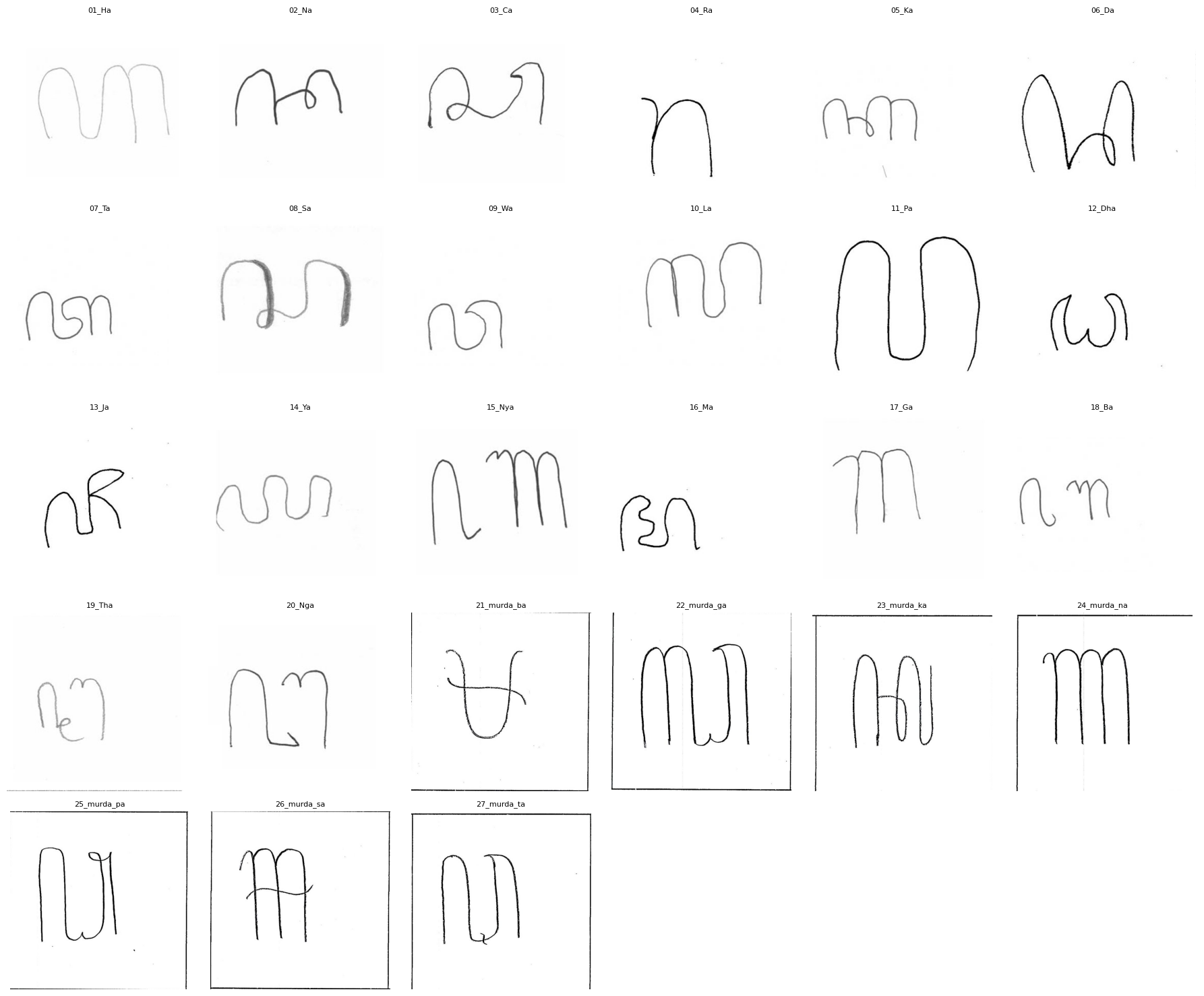
The study adopts an experimental design for multi-class Javanese Aksara recognition, in which four alternative preprocessing configurations are evaluated under a fixed Vision Transformer backbone. All experiments use the publicly available RayFox52 “Aksara-jawa-carakan-murda” dataset hosted on the Hugging Face repository, which contains images of Javanese characters captured under relatively homogeneous conditions. The dataset comprises 6,642 RGB images distributed uniformly across 27 character classes, resulting in 246 images per class. Each image is stored in a class-specific folder whose name matches the corresponding Javanese Aksara label, enabling automatic mapping between file paths and class indices during data loading. After download, the dataset is validated by iterating through all image files and attempting library-level decoding; files that fail to open, have inconsistent channels, or produce runtime errors are flagged as corrupted and would be removed. In the present dataset, no corrupted samples were detected, so all 6,642 images were retained. A class distribution analysis confirms exact balance across the 27 categories, which simplifies the interpretation of macro-averaged performance metrics and reduces the need for class weighting [2]. To ensure reproducibility, a fixed random seed is applied consistently for file shuffling, stratified splitting, and mini-batch sampling [24]. This design supports a controlled comparison of preprocessing pipelines because only image enhancement differs across experimental arms, whereas data, architecture, and hyperparameters are held constant [25].
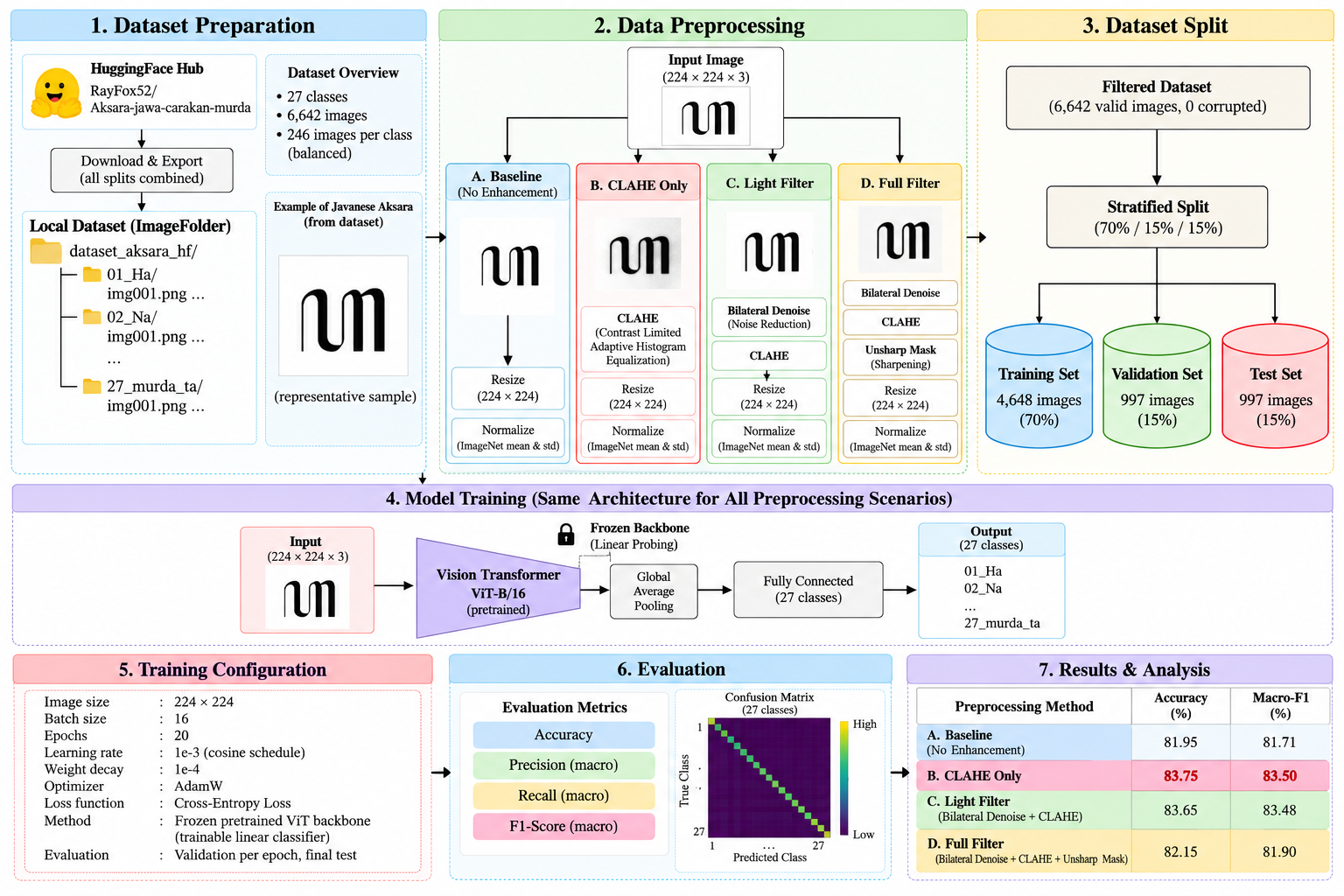
Flowchart of the recognition pipeline: Javanese Aksara images from the 27-class RayFox52 dataset pass through one of four preprocessing branches (baseline; CLAHE only; bilateral filter plus CLAHE; bilateral filter, CLAHE and unsharp masking), then a shared stratified 70/15/15 split, a frozen ImageNet-pretrained ViT-B/16 backbone with a trained linear classification head, and evaluation by accuracy and macro-averaged metrics.
3.2 CLAHE-Based Image Preprocessing Pipeline
Four preprocessing scenarios are defined to quantify the effect of contrast enhancement and filtering on Vision Transformer classification performance. In the baseline configuration, each RGB image is resized to pixels, normalized using the standard ImageNet channel-wise mean and standard deviation , and augmented during training by a small random in-plane rotation, sampled from a narrow interval to preserve character legibility [1]. In the second configuration, Contrast Limited Adaptive Histogram Equalization (CLAHE) is applied prior to resizing and normalization to enhance local contrast while constraining the amplification of noise. CLAHE operates by computing localized histograms over contextual tiles and applying a clip limit to the cumulative distribution before mapping intensities [10]; [11]. In the third configuration, a bilateral filter is applied before CLAHE, with the aim of reducing background noise while preserving character edges and stroke boundaries [3]. The bilateral filter replaces each pixel by a weighted average of neighboring intensities, where weights depend jointly on spatial proximity and photometric similarity, thereby smoothing homogeneous regions without blurring high-frequency contours. In the fourth configuration, unsharp masking is added after bilateral denoising and CLAHE, sharpening stroke edges by subtracting a blurred version of the image from the original and linearly recombining the two. In all scenarios, images are ultimately resized to , normalized with ImageNet statistics, and subjected to the same mild random rotation policy. Because the architecture, optimizer, and data splits are identical across arms, the design isolates the effect of CLAHE and additional filtering on recognition performance, enabling a controlled ablation in line with reproducible preprocessing studies [25]; [12].
3.3 Dataset Splitting and Experimental Protocol
To evaluate generalization under a fixed and leakage-safe protocol, the 6,642 images are partitioned once into training, validation, and test subsets using a stratified 70/15/15 split. Stratification is performed at the class level so that each subset preserves the global label distribution, i.e., 246 images per class are divided into 172 training, 37 validation, and 37 test instances, yielding 4,648 training images, 997 validation images, and 997 test images overall [2]. Stratified indices are generated using the fixed random seed, and these index sets are stored and reused across all four preprocessing configurations. Partitioning is executed on the raw image list prior to any enhancement, denoising, sharpening, or augmentation operations, thereby preventing any form of cross-split contamination [24]. Once the split is fixed, each experimental arm independently applies its designated preprocessing pipeline to the training, validation, and test images assigned to it. This procedure guarantees that models trained under different preprocessing scenarios see exactly the same underlying character instances in each subset, enabling a direct comparison of test accuracy and macro-averaged metrics without confounding changes in data composition [26].
3.4 Vision Transformer Architecture and Training Configuration
All experiments rely on the ViT-B/16 architecture pretrained on ImageNet as the visual backbone. The model decomposes each input into non-overlapping patches of size , linearly projects each patch to an embedding vector, and processes the resulting token sequence with stacked multi-head self-attention and feed-forward layers [23]. In this study, the pretrained backbone is kept frozen, and only the final classification head is replaced and trained. Specifically, the original head is substituted with a task-specific linear layer that maps the backbone’s final representation to a 27-dimensional logit vector corresponding to the Javanese Aksara classes, implementing a linear probing strategy suitable for moderate-sized datasets [27]; [1]. Training is conducted with a batch size of 16 for 20 epochs using the AdamW optimizer, with an initial learning rate of , weight decay , and a cosine annealing schedule that progressively reduces the learning rate towards zero over the course of training [28]. The model is optimized with the standard cross-entropy loss, defined for a single sample as
| (1) |
where is the number of classes, is the one-hot encoded ground-truth label, and is the predicted softmax probability for class . Validation Macro-F1 is monitored after each epoch, and the set of head parameters that achieves the highest validation Macro-F1 is retained for final evaluation on the held-out test set [29]. This procedure is applied identically to all four preprocessing configurations, ensuring that training differences do not bias the ablation results.
3.5 Performance Evaluation and Ablation Analysis
Model performance is assessed on the test set using accuracy, macro-averaged precision, macro-averaged recall, and Macro-F1, which are computed across the 27 classes to reflect performance on both frequent and rare labels equally [1]. For each class , precision and recall are defined as
| (2) |
where , , and denote true positives, false positives, and false negatives for class , respectively. The F1-score per class is
| (3) |
, and the Macro-F1 is obtained by averaging uniformly over all classes. This macro-averaging emphasizes balanced performance and is particularly informative in the presence of visually similar characters, where confusions can be systematic rather than random [26]. In addition, 27×27 confusion matrices are generated for each preprocessing scenario to inspect class-level error patterns, including frequent misclassifications among structurally related Aksara forms. The four preprocessing configurations are compared under the same architecture, data split, and training configuration, enabling a controlled ablation analysis [25]. The results, summarized in Figure 3, show that the CLAHE-only pipeline achieves the highest test accuracy and Macro-F1, with values around 83.75% and 83.50%, respectively, while the baseline, denoising-plus-CLAHE, and full filtering pipelines yield slightly lower yet comparable metrics. These findings suggest that local contrast enhancement alone is beneficial for Javanese Aksara recognition, whereas additional bilateral denoising and unsharp masking may remove subtle stroke information or introduce artifacts that degrade classification.
Methodologically, Figure 1 integrates the complete workflow from dataset acquisition through preprocessing, splitting, model training, and evaluation, visually emphasizing that only the preprocessing branch varies across the four ablation arms. By fixing all other components, the figure underscores the study’s focus on isolating the contribution of CLAHE and associated filters to Javanese Aksara classification performance under a reproducible, transformer-based recognition framework.
4 Results
4.1 Test Performance Comparison Across Preprocessing Methods
Across the four preprocessing configurations, all models achieved relatively high performance on the 27-class Javanese Aksara test set, with accuracy and Macro-F1 clustered in the 0.82–0.84 range. The baseline ViT without explicit contrast enhancement obtained a test accuracy of 0.8195 and a Macro-F1 of 0.8171. Introducing CLAHE as a standalone preprocessing operation yielded the best overall results, with a test accuracy of 0.8375 and Macro-F1 of 0.8350. The Light Filter configuration, which combined bilateral denoising with CLAHE, reached a comparable accuracy of 0.8365 and Macro-F1 of 0.8348. In contrast, the Full Filter pipeline—which added unsharp masking on top of bilateral filtering and CLAHE—offered only a modest improvement over baseline (accuracy 0.8215, Macro-F1 0.8190). Taken together, these outcomes indicate that CLAHE-based local contrast enhancement is beneficial for ViT-based Javanese Aksara recognition, but that more aggressive filtering and sharpening do not provide additional gains under the current settings. The pivot analysis shows that CLAHE Only improves Macro-F1 over the baseline by approximately +0.018, while the Light Filter achieves a similar gain and the Full Filter’s improvement remains marginal. Because all experiments share identical data splits, architecture, and optimization hyperparameters, the observed differences can be attributed to the preprocessing choices, supporting the conclusion that CLAHE alone is an effective and sufficient enhancement step in this context.
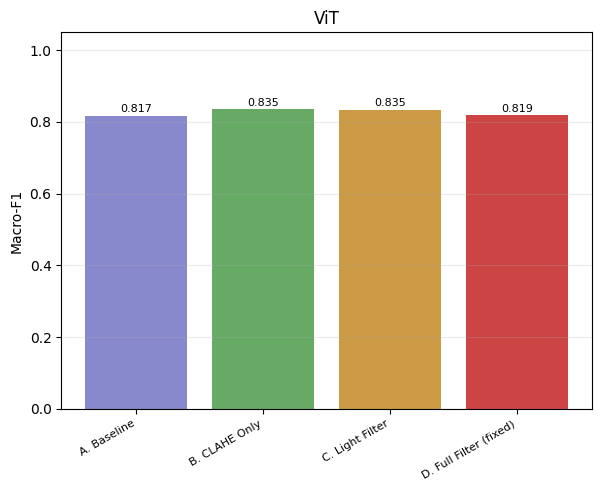
Bar chart of test Macro-F1 for ViT-B/16 under the Baseline, CLAHE Only, Light Filter and Full Filter configurations; all four bars lie between about 0.817 and 0.835, with CLAHE Only highest at about 0.835.
4.2 Validation Accuracy Across Training Epochs
The validation accuracy trajectories over 20 epochs further illustrate the impact of preprocessing on optimization. All four configurations start from broadly similar accuracy levels around 0.61–0.62 at epoch 1 and exhibit rapid improvements during the first 5–7 epochs, followed by slower, asymptotic gains. By the end of training, validation accuracy plateaus above 0.81 in every scenario, with clear but modest separation among pipelines. The CLAHE Only configuration consistently tracks near the top of the accuracy curves and attains its peak validation accuracy of 0.8405 at epoch 19. The Light Filter and Full Filter variants are also competitive, with peak validation accuracies in the 0.83–0.84 range, while the baseline remains systematically lower across most epochs and stabilizes around 0.81–0.82. Notably, the relative ordering observed during training is mirrored in the final test metrics, although the best single-epoch validation accuracy (e.g., for Full Filter) does not always translate into the highest test Macro-F1. This suggests that preprocessing influences the learning dynamics of the linear head on top of the frozen ViT backbone, shaping both early optimization and final generalization.
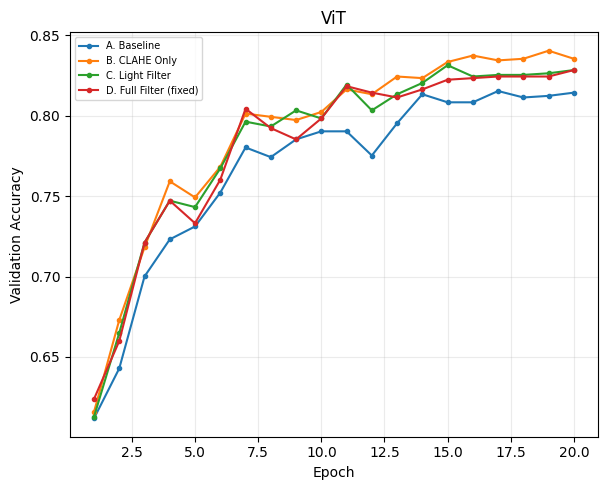
Line chart of validation accuracy over 20 epochs for the four preprocessing configurations; all curves start near 0.61 to 0.62, rise steeply during the first 5 to 7 epochs and plateau above 0.81, with CLAHE Only peaking at 0.8405 in epoch 19.
4.3 Validation Macro-F1 Across Training Epochs
The validation Macro-F1 curves provide a class-balanced view of training progress. All configurations begin with Macro-F1 values near 0.60 at epoch 1 and exhibit a monotonic upward trend with occasional small fluctuations, indicating that improvements in accuracy largely reflect consistent gains across classes rather than being dominated by a subset of easier characters. The CLAHE Only model shows the steepest early gains, surpassing 0.80 Macro-F1 by around epoch 11 and achieving a maximum of 0.8379 at epoch 19. The Light Filter and Full Filter pipelines attain competitive Macro-F1 scores, eventually converging in the 0.82–0.83 range, while the baseline remains lower throughout, with a best validation Macro-F1 of 0.8140. Because Macro-F1 weights each of the 27 classes equally, these results imply that CLAHE-only preprocessing improves recognition not only of frequent or visually distinctive characters but also of more confusable or structurally similar Aksara forms, including Murda variants.
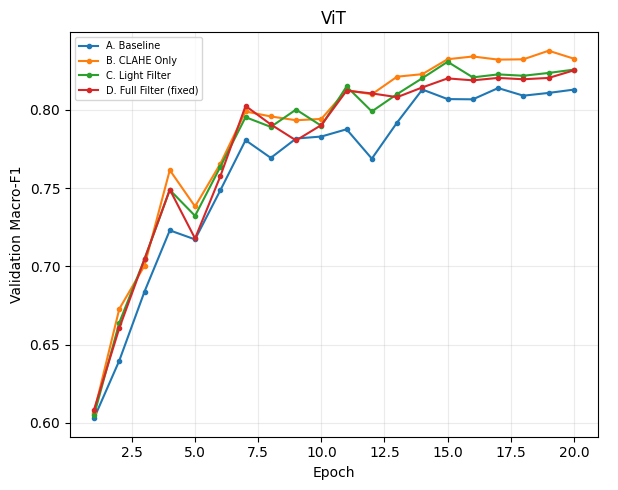
Line chart of validation Macro-F1 over 20 epochs for the four preprocessing configurations; the curves rise monotonically with small fluctuations, CLAHE Only highest with 0.8379 by epoch 19 and the baseline lowest with a best value of 0.8140.
4.4 Validation Loss and Convergence Analysis
Validation loss curves complement the accuracy and Macro-F1 analyses by clarifying convergence behavior. For all four configurations, validation loss decreases sharply during the first 5 epochs, reflecting rapid adaptation of the newly initialized classification head, and then continues to decline more gradually. By epoch 20, losses appear to have largely stabilized, consistent with the plateauing of validation metrics. Among the four pipelines, CLAHE Only achieves the lowest final validation loss at 0.5316, followed by Light Filter at 0.5497, Full Filter at 0.5574, and the baseline at 0.6007. The consistent gap between the baseline and the three enhanced pipelines across epochs indicates that improved contrast, with or without additional filtering, makes the ViT features more linearly separable for Javanese characters. The alignment between lower validation loss and higher Macro-F1 for CLAHE Only suggests that the gains are not due solely to chance favorable calibration at a single epoch, but reflect a more robust convergence regime. Nonetheless, the relatively small absolute differences among the three contrast-enhanced configurations point to diminishing returns from additional filtering operations beyond CLAHE.
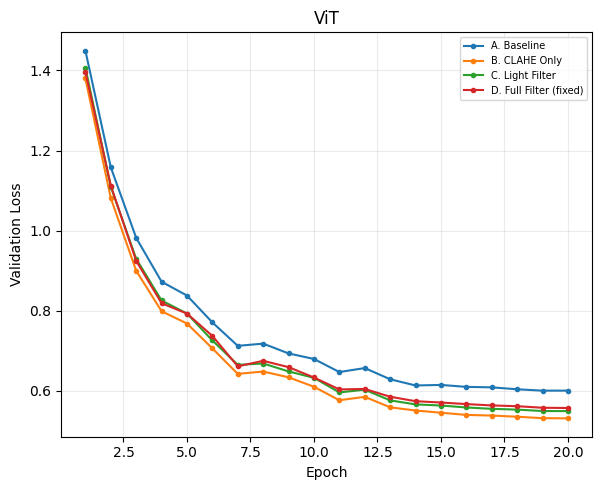
Line chart of validation loss over 20 epochs for the four preprocessing configurations; loss falls sharply during the first 5 epochs and then stabilises, ending lowest for CLAHE Only (0.5316) and highest for the baseline (0.6007).
5 Discussion
5.1 Effectiveness of CLAHE for Javanese Aksara Recognition
The experimental results demonstrate that CLAHE-based preprocessing yields consistent improvements in both validation and test performance for ViT-based Javanese Aksara recognition. The CLAHE Only pipeline attains the highest test Macro-F1 (0.8350) and the lowest validation loss, outperforming the baseline by nearly two percentage points in Macro-F1. These findings support the broader claim in handwriting-recognition literature that local contrast enhancement can mitigate low-contrast backgrounds and emphasize discriminative stroke patterns [6]; [10]. They also resonate with prior reports that CLAHE is particularly effective when applied with carefully tuned parameters, avoiding over-amplification of noise or background texture [11]; [19]. In the context of Javanese script, which contains dense, curvilinear glyphs and subtle distinctions among basic and Murda characters, the observed gains suggest that CLAHE helps the frozen ViT backbone to preserve and exploit fine structural information that might otherwise be attenuated by global normalization alone. Compared to previous Javanese studies that incorporate preprocessing without systematic ablation [1]; [3], this work isolates CLAHE’s contribution under matched conditions and shows that even with a simple linear probe, contrast enhancement can provide practically meaningful improvements.
5.2 Interaction between Filtering, Sharpening, and Transformer Features
The comparative performance of Light Filter and Full Filter reveals that additional denoising and sharpening do not necessarily translate into further gains. While bilateral filtering plus CLAHE (Light Filter) remains competitive with CLAHE Only, the addition of unsharp masking (Full Filter) reduces both validation and test metrics, despite slightly higher validation accuracy at some intermediate epochs. This pattern is consistent with prior observations that overly aggressive preprocessing—such as strong thinning or hard binarization—can remove useful stroke detail and harm recognition performance in Javanese OCR [3]. From a transformer perspective, the ViT-B/16 backbone is pretrained on natural images and may rely on subtle texture and intensity gradients within patches [23]. Excessive denoising or sharpening can distort these gradients, effectively altering the distribution of patch embeddings in ways that reduce linear separability for the new task. The results therefore caution against blindly stacking multiple enhancement operations in transformer-based OCR pipelines and underscore the value of minimal, well-justified preprocessing tailored to script characteristics [10]; [14].
5.3 Comparison with CNN-Based and Hybrid Javanese Approaches
Although the absolute accuracies reported here are lower than the ¿97% figures achieved by large CNN models on curated or simpler Javanese datasets [2]; [17], direct comparison is complicated by differences in class inventory, data size, and experimental protocols [1]. The present study targets a 27-class setting with a modest number of samples per class and employs a frozen ViT backbone with only the classification head trained, a configuration known to underperform full fine-tuning or deeper adaptations on small datasets [14]; [20]. Within this constrained regime, the observed 0.83–0.84 Macro-F1 suggests that ViT-based recognition is competitive, especially when coupled with CLAHE. Existing transformer-based handwriting systems often rely on extensive pretraining or hybrid CNN–ViT tokenizers to achieve strong performance [7]; [14]; [13]. The results here extend that evidence to Javanese Aksara by demonstrating that even a standard ViT-B/16 can perform reasonably well when supported by appropriate contrast preprocessing. At the same time, the persistent gap to the best CNN-based Javanese systems implies that further gains likely require either end-to-end fine-tuning of the transformer, architectural adaptations, or larger and more heterogeneous training corpora [5]; [21].
5.4 Limitations and Implications for Future Work
Several limitations qualify the conclusions of this study. First, all experiments rely on a single balanced dataset captured under relatively homogeneous conditions, whereas real-world Javanese materials may involve diverse writing styles, scanning artifacts, and layout complexities [1]; [2]. Second, only one ViT backbone and a linear probing strategy were explored; alternative transformer variants or partial fine-tuning could interact differently with CLAHE and filtering [20]; [22]. Third, the study uses a single random split and random seed, so while the performance differences are consistent and mechanistically plausible, additional replicated runs would be needed to assess statistical robustness. Despite these constraints, the findings have several practical implications. For designers of Javanese OCR systems, the results suggest that CLAHE alone is a strong default choice for preprocessing, offering measurable gains with minimal complexity. For the broader low-resource script community, the controlled ablation across four pipelines illustrates how contrast-aware preprocessing can be systematically evaluated with transformer backbones, addressing a common gap in prior work where such steps are treated as fixed engineering details [10]; [14]. Future research could extend this approach by combining CLAHE with data-efficient transformer fine-tuning, by exploring adaptive or learning-based enhancement methods [11], and by validating the pipeline on larger, more varied Javanese corpora and related scripts [5]; [7].
6 Conclusions
This study has demonstrated that a Vision Transformer architecture, when combined with a CLAHE-based preprocessing pipeline, can effectively recognize 27 classes of Javanese Aksara characters, including standard and murda forms, from a balanced dataset of 6,642 images. Across four preprocessing scenarios, the CLAHE-only pipeline achieved the best overall performance, yielding a test accuracy of 83.75% and a macro F1-score of 0.8350, representing an improvement of approximately 0.018 in macro F1 over the baseline ViT without CLAHE. The light and full filtering pipelines also produced competitive gains relative to the baseline, but did not surpass the CLAHE-only configuration, indicating that contrast-limited adaptive histogram equalization alone already provides a substantial and efficient enhancement to character distinguishability for transformer-based recognition. The findings underscore the importance of tailored contrast enhancement for complex script recognition tasks, where subtle stroke variations and visually similar glyphs are prominent. By systematically comparing multiple preprocessing configurations under identical model and training settings, this work clarifies that CLAHE constitutes a simple yet impactful preprocessing step that improves both generalization and class-wise balance, as reflected in the macro F1 results. These contributions are particularly relevant for the development of automated reading systems, digital archives, and educational tools aimed at preserving and promoting Javanese script literacy, where robust and scalable recognition of diverse character forms is essential. Despite these promising results, several limitations should be acknowledged. The experiments were conducted on a single, balanced dataset, which may not fully capture the variability present in real-world documents, such as handwritten forms, historical manuscripts, and noisy or degraded images. Furthermore, the study focused on isolated character recognition without addressing ligatures, diacritics, or contextual dependencies at the word or sentence level. The computational cost of ViT training and inference, as evidenced by the relatively long processing times, also suggests the need to consider efficiency alongside accuracy in practical deployments. Future research should therefore explore domain adaptation and augmentation strategies to handle more heterogeneous and low-quality sources, investigate lighter or distilled transformer variants for resource-constrained environments, and extend the approach to sequence-level recognition that incorporates contextual modeling of Javanese orthography. Integrating the proposed CLAHE-based preprocessing with end-to-end pipelines for line and word recognition, as well as evaluating performance on historical and handwritten corpora, constitutes a natural progression to further advance automated Javanese Aksara understanding.
Declarations
Data Availability Statement: The study uses the publicly available RayFox52 “Aksara-jawa-carakan-murda” dataset hosted on the Hugging Face repository, as described in the Methodology section.
References
- [1] N. Fateah, S. Subhan, and Y. N. Ifriza, “Optimizing Javanese script recognition using fine-tuned ResNet-18 and transfer learning,” IAES Int. J. Artif. Intell. (IJ-AI), vol. 15, no. 1, pp. 443–453, 2026. doi: 10.11591/ijai.v15.i1.pp443-453.
- [2] A. Susanto, I. U. W. Mulyono, C. A. Sari, E. H. Rachmawanto, D. R. I. M. Setiadi, and M. K. Sarker, “Improved Javanese script recognition using custom model of convolution neural network,” Int. J. Electr. Comput. Eng. (IJECE), vol. 13, no. 6, pp. 6629–6636, 2023. doi: 10.11591/ijece.v13i6.pp6629-6636.
- [3] M. A. Rasyidi, T. Bariyah, Y. I. Riskajaya, and A. D. Septyani, “Classification of handwritten Javanese script using random forest algorithm,” Bull. Electr. Eng. Inform., vol. 10, no. 3, pp. 1308–1315, 2021. doi: 10.11591/eei.v10i3.3036.
- [4] A. Moudgil, S. Singh, S. Rani, M. Shabaz, and S. Alsubai, “Deep learning for ancient scripts recognition: A CapsNet-LSTM based approach,” Alexandria Eng. J., vol. 103, pp. 169–179, 2024. doi: 10.1016/j.aej.2024.06.007.
- [5] A. A. Thazhath, B. P. Chacko, and M. B. K. Parambath, “Vision transformer and hybrid models for Malayalam handwritten word recognition,” IAES Int. J. Artif. Intell. (IJ-AI), vol. 15, no. 3, pp. 2655–2663, 2026. doi: 10.11591/ijai.v15.i3.pp2655-2663.
- [6] V. K. Chauhan, S. Singh, and A. Sharma, “HCR-Net: a deep learning based script independent handwritten character recognition network,” Multimedia Tools Appl., vol. 83, no. 32, pp. 78433–78467, 2024. doi: 10.1007/s11042-024-18655-5.
- [7] P. Pragada and D. R. Ch, “Improved recognition of Telugu handwritten characters through synthetic data generation and attention-based modeling,” Eng. Res. Express, vol. 8, no. 17, p. 175231, 2026. doi: 10.1088/2631-8695/ae9c8f.
- [8] P. Härtinger and C. Steger, “Adaptive histogram equalization in constant time,” J. Real-Time Image Process., vol. 21, no. 3, 2024. doi: 10.1007/s11554-024-01465-1.
- [9] U. Kuran and E. C. Kuran, “Parameter selection for CLAHE using multi-objective cuckoo search algorithm for image contrast enhancement,” Intell. Syst. Appl., vol. 12, p. 200051, 2021. doi: 10.1016/j.iswa.2021.200051.
- [10] I. Majid Mohammed and N. Ashidi Mat Isa, “Contrast limited adaptive local histogram equalization method for poor contrast image enhancement,” IEEE Access, vol. 13, pp. 62600–62632, 2025. doi: 10.1109/access.2025.3558506.
- [11] A. Fawzi, A. Achuthan, and B. Belaton, “Adaptive clip limit tile size histogram equalization for non-homogenized intensity images,” IEEE Access, vol. 9, pp. 164466–164492, 2021. doi: 10.1109/access.2021.3134170.
- [12] M. Ritonga, M. L. Bangare, P. M. Bangare, S. L. Bangare, S. S. Vanjire, K. Moholkar, et al., “Optimized convolutional neural network deep learning for Arabian handwritten text recognition,” Bull. Electr. Eng. Inform., vol. 14, no. 2, pp. 1497–1506, 2025. doi: 10.11591/eei.v14i2.7696.
- [13] J. Ma, Y. Bai, B. Zhong, W. Zhang, T. Yao, and T. Mei, “Visualizing and understanding patch interactions in vision transformer,” IEEE Trans. Neural Netw. Learn. Syst., vol. 35, no. 10, pp. 13671–13680, 2024. doi: 10.1109/tnnls.2023.3270479.
- [14] Y. Li, D. Chen, T. Tang, and X. Shen, “HTR-VT: Handwritten text recognition with vision transformer,” Pattern Recognit., vol. 158, p. 110967, 2025. doi: 10.1016/j.patcog.2024.110967.
- [15] Y. Dan, Z. Zhu, W. Jin, and Z. Li, “S-Swin Transformer: simplified Swin Transformer model for offline handwritten Chinese character recognition,” PeerJ Comput. Sci., vol. 8, p. e1093, 2022. doi: 10.7717/peerj-cs.1093.
- [16] S. Geng, Z. Zhu, Z. Wang, Y. Dan, and H. Li, “LW-ViT: The lightweight vision transformer model applied in offline handwritten Chinese character recognition,” Electronics, vol. 12, no. 7, p. 1693, 2023. doi: 10.3390/electronics12071693.
- [17] D. U. K. Putri, D. N. Pratomo, and A. Azhari, “Hybrid convolutional neural networks-support vector machine classifier with dropout for Javanese character recognition,” TELKOMNIKA (Telecommun. Comput. Electron. Control), vol. 21, no. 2, p. 346, 2023. doi: 10.12928/telkomnika.v21i2.24266.
- [18] O. Akallouch, M. Akallouch, and K. Fardousse, “TifinNet: CNN–Transformer hybrid architecture for Tifinagh handwritten recognition,” IEEE Access, vol. 14, pp. 34830–34844, 2026. doi: 10.1109/access.2026.3669937.
- [19] Z. Yu, H. Zhao, Z. Li, Y. Pan, and X. Guo, “Stall-free software–hardware co-design for perception-driven contrast-limited adaptive histogram equalization,” ACM Trans. Embed. Comput. Syst., vol. 25, no. 6, pp. 1–24, 2026. doi: 10.1145/3847669.
- [20] C. Meng, W. Lin, B. Liu, H. Zhang, Z. Gan, and C. Ouyang, “RTS-ViT: Real-time share vision transformer for image classification,” IEEE J. Biomed. Health Inform., vol. 29, no. 5, pp. 3576–3586, 2025. doi: 10.1109/jbhi.2024.3525054.
- [21] Y. Liu, Y.-H. Wu, G. Sun, L. Zhang, A. Chhatkuli, and L. Van Gool, “Vision transformers with hierarchical attention,” Mach. Intell. Res., vol. 21, no. 4, pp. 670–683, 2024. doi: 10.1007/s11633-024-1393-8.
- [22] N. Ebert, D. Stricker, and O. Wasenmüller, “PLG-ViT: Vision transformer with parallel local and global self-attention,” Sensors, vol. 23, no. 7, p. 3447, 2023. doi: 10.3390/s23073447.
- [23] Y. Bazi, L. Bashmal, M. M. Al Rahhal, R. Al Dayil, and N. Al Ajlan, “Vision transformers for remote sensing image classification,” Remote Sens., vol. 13, no. 3, p. 516, 2021. doi: 10.3390/rs13030516.
- [24] M. Rifqi Azkiya Jamaludin and C. S. Kim, “Evaluation integrity in hybrid quantum-classical skin lesion classification: A data-leakage audit and lesion-level correction on HAM10000,” IEEE Access, vol. 14, pp. 101415–101428, 2026. doi: 10.1109/access.2026.3707673.
- [25] Abdullah, M. A. Ather, Z. Fatima, J. L. O. Rodríguez, C. G. Sánchez-Mejorada, R. Q. Téllez, et al., “An attention-enhanced ViT-HLNN hybrid ensemble framework for multi-class gastrointestinal disease classification,” Sci. Rep., vol. 16, no. 1, 2026. doi: 10.1038/s41598-026-51410-4.
- [26] A. Maarouf, O. Maarouf, A. Benaiss, R. El Ayachi, and M. Biniz, “Arabic sign language alphabet recognition using transfer learning: Evaluation, ablation, and deployment,” Int. J. Adv. Comput. Sci. Appl. (IJACSA), vol. 17, no. 6, 2026. doi: 10.14569/ijacsa.2026.0170657.
- [27] Y. Wang, Y. Deng, Y. Zheng, P. Chattopadhyay, and L. Wang, “Vision transformers for image classification: A comparative survey,” Technologies, vol. 13, no. 1, p. 32, 2025. doi: 10.3390/technologies13010032.
- [28] K. C. Pavithra, P. Kumar, M. Geetha, S. V. Bhandary, K. B. Ajitha Shenoy, G. Rao, et al., “Transformer-based DME classification using retinal OCT images without data augmentation: An evaluation of ViT-B16 and ViT-B32 with optimizer impact,” IEEE Access, vol. 13, pp. 180781–180798, 2025. doi: 10.1109/access.2025.3620945.
- [29] D. Zhang, J. Li, Y. Xie, and A. Wulamu, “Research on performance variations of classifiers with the influence of pre-processing methods for Chinese short text classification,” PLOS ONE, vol. 18, no. 10, p. e0292582, 2023. doi: 10.1371/journal.pone.0292582.